


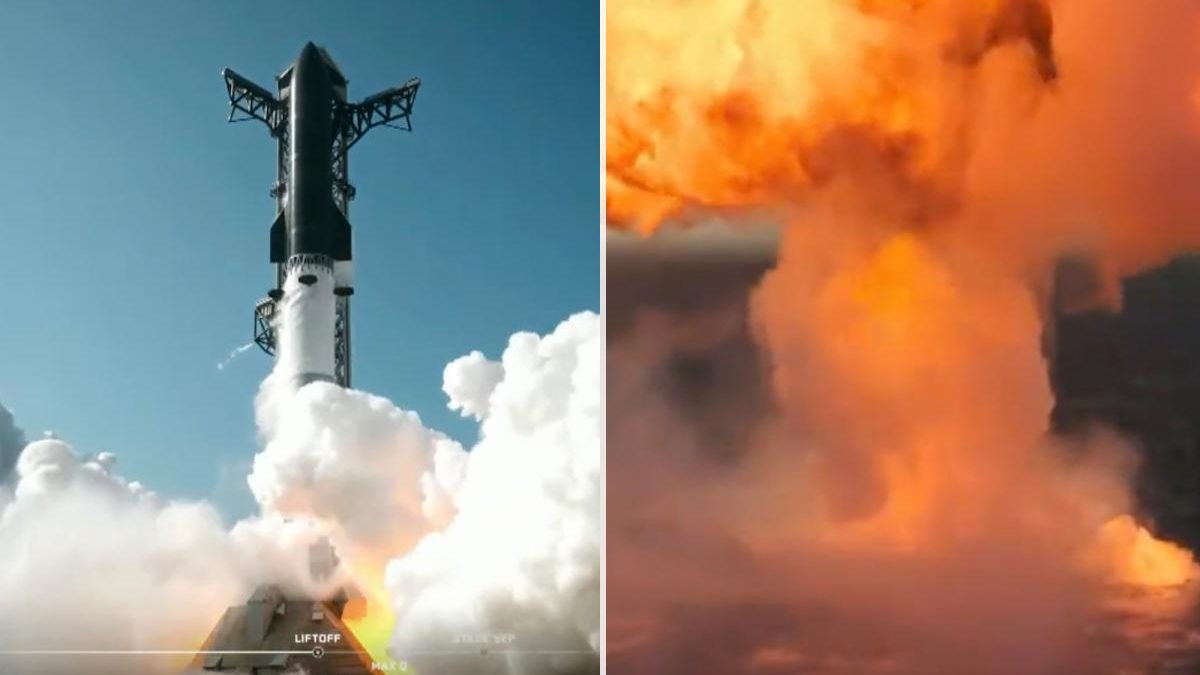
SpaceX’s Starship 12 rocket had a successful launch Friday night, before its suborbital test run around the Earth concluded with a stunning fireball explosion as it splashed down in the Indian Ocean.
The rocket’s launch — the largest and most powerful of its kind — took place at around 6:30 p.m. EST and the 66-minute test flight was deemed a success by SpaceX.
A launch was aborted Thursday night due to problems with the temperature of the propellants inside the tanks.
SpaceX confirmed that Friday’s fireball eruption was planned since they don’t plan on reutilizing the experimental spacecraft.
During it’s more than hour-long mission, the rocket didn’t go into full orbit and was a pivotal step in testing how new hardware within Starship fares under real flight conditions, SpaceX said.
V3 of Starship 12 contained two key features — the ‘Super Heavy’ bottom booster stage with 33 powerful engines and the Starship, which is the upper part of the spacecraft above the booster that has its own engines.
A few minutes after launch, the ‘Super Heavy’ booster separated and conducted a ‘boostback’ burn to slow down before splashing down in the Gulf of America — unlike previous missions that attempted landing back at the launch site.
Meanwhile, the upper Starship spacecraft continued into space and released 22 fake Starlink satellites 20 minutes into the flight.
Following the launch, the aerospace company founded by Elon Musk began critical trials before NASA can use the third version of Starship to launch astronauts to the moon and beyond.
The launch cost Starship one of its six new ‘Raptor’ engines and was forced to burn the remaining five engines longer to compensate.
During the flight, SpaceX noted that a scheduled restart of one of the spacecraft’s engines was aborted due to the loss of one of the engines.
SpaceX tested Starship’s heat shields by purposely removing one panel to test how it would hold up under extreme stress. Despite this, Flight 12 made it through the Earth’s atmosphere intact.
As the rocket passed through the atmosphere without burning up, it adjusted its course to reach a final landing spot, plunging into the Indian Ocean.
The sprawling rocket was able to complete a majority of its planned mission throughout the 66-minute flight and successfully reentered the Earth’s atmosphere before landing in the ocean.
Musk and his team are hopeful that this version of Starship will be the one NASA uses to carry astronauts to the moon’s surface as soon as 2028 when Artemis IV is scheduled to launch.
SpaceX eventually plans to send Starship V3 to Mars with humans and cargo to establish the first self-sustaining city on the Red Planet.
Source